Lately, I’ve gone back to writing by hand — I mean writing a lot by hand, not just a few notes. A kind of nostalgia for matter, in this increasingly digital world. At first, it was a game, a bit of curiosity: I finally learned to write in lowercase block letters and to draw capital letters with serifs (those little lines that, in Italian, are called grazie). But as the pages started to pile up, a much deeper meaning began to emerge: the value of slowness.
This was the topic of one of the long journeys to Zurich that I take from time to time with my friend and brother Ivan Tibolla, an excellent pianist and flutist, as we head to concerts with Marco Santilli’s nonet and quartet — a visionary and hyper-creative Swiss clarinetist.
Few things are as beautiful as those long car rides, during which we slowly wind our way through the mostly useless trails of our thoughts. So here is a little account of one of them.
“Understanding is not doing“
It all starts with a phrase by Luigi Tito, an extraordinary painter from Veneto, who used to say: “Looking is not seeing, seeing is not understanding, understanding is not doing”, thus distinguishing various depths in the visual experience. We could translate that same phrase into music like this: “Hearing is not listening, listening is not understanding, understanding is not doing.”
It may sound complicated, but it’s not. After all, we only have three senses: sight, hearing, and touch. The first two perceive frequencies and vibrations — light or sound — and are senses that can reach far. Certainly the most powerful among them is sight: on a clear day we can see even the most distant mountain peaks. But hearing too can catch events relatively far from us. In contrast, touch — whether in its strict sense or as taste or smell — requires close contact with matter.
It’s a fact: the more powerful the sense, the less the subject is involved. If I watch a pianist perform, I receive so much that I can only sit back and enjoy it. But if I listen to a piano piece, maybe from an old vinyl record, I’m required to make an effort of abstraction — a creative effort to turn what I hear into something meaningful. And yet, the most engaging experience of all is playing that piece — in other words, using touch. I'm not suggesting you lick or sniff the keys of a piano, but if you want a clearer example, think of the person you love, and the difference between seeing them from afar, hearing them, or touching them. That’s what music is like.
But moving from listening — or watching — to doing takes time. A lot of time. An immense, boundless amount of time. And this is where the value of slowness comes in, along with my silly habit of writing by hand.
The Love of Slowness
When I think, my ideas are like vapor; when I speak, they become liquid; and when I write, they become solid. And if I write them by hand — much more slowly — they become even more solid.
Slowness is essential to move from understanding to doing, yet we often consider only the time spent understanding to be time well spent. It's a false criterion of efficiency, widespread and often exploited by those who promise to help you learn and achieve endless things in no time across countless fields.
I believe, on the contrary, that the time spent doing is worthwhile precisely because it is slow. Because experience builds up gradually, concepts need a natural rhythm to settle in — not just to be memorized, but to be lived, to become actions that are truly effective.
Then, from time to time — and suddenly — often after long stretches of apparent stillness, the quality of our actions leaps upward: like a ‘click’, a quantum leap, a dam overflowing. This is what I feel to be the experience of growth, and I believe it's at the heart of almost everything that is beautiful and meaningful — from playing a musical instrument to baking bread (something I'm currently practicing with spectacular lack of success).
It takes time. And perhaps we should learn to fall in love with slowness again — because it transforms mere knowledge into real experience and tangible things.
All the Points of the Circle
This also applies to teaching. Let’s imagine music as a circle, and a good musician as someone who knows how to move freely within that circle. Traditional music education follows a vertical, linear approach: it aims to cover every point on the circle just once, in a logical and sequential manner. Starting from one point on the circumference, it follows a spiral path toward the center, trying to exhaust all possible topics in the shortest time, with an appearance of maximum efficiency.

By contrast, a path we might call holistic or non-linear moves from one point to another more randomly — seemingly inefficient and redundant.

The advantages of this second method are many, but three stand out:
– First, since it’s not directly tied to rationality, it draws upon the emotional, intuitive, instinctive, creative, and spiritual dimensions of the individual, providing a powerful inner drive to learn.
– Second, the redundancy of the connections — though weaker, less certain, and more imperfect than those in a linear path — weaves a more robust fabric of knowledge, transforming it into memory and then into action. Each individual link may be fragile, but the overall weave is much stronger.
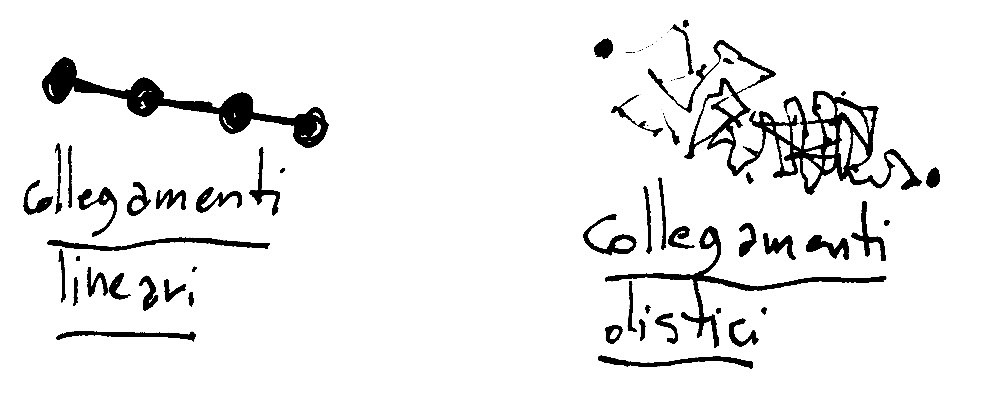
– Lastly, the holistic path includes the linear one: among all the possible sequential connections, the linear spiral is also present. This means it’s possible to harmonize the two approaches starting from the holistic one, while the reverse is not.
Naturally, a study program built this way might create anxiety in more rational students, and it could stretch what is traditionally a one-year curriculum into five years, for example. But it also transforms knowledge into real action — and I firmly believe that, at least for a music teacher, the goal should be to teach how to do, more than to teach what to know.
Finding Time
Many students feel disheartened when they realize the immense amount of time required to reach the goal they’ve set for themselves. Most of the time, they have no idea how many hours their teacher has spent turning a simple concept — explained and understood in just a few minutes — into solid practice: more often than not, it has taken an entire lifetime. They don’t realize it, and that’s completely natural. But when they finally catch a glimpse of that vast territory made up of hour upon hour of practice, they often lose heart — and sadly, sometimes they give up.
This usually happens because the reason behind their study of music is external (social or economic gratification, for example), or shallow (fun, relaxation, etc.). As a result, they are overcome by a lack of time — which in truth is often caused by disorganization or laziness. That may sound a little harsh, but consider how much time is spent in front of TVs and smartphones.
On the other hand, those who are driven by an inner force — what we might call a spiritual force of progress — truly manage to reclaim their time, transforming it into a space for incredibly slow experiences that bring genuine happiness. That’s where the real value of music lies.