Everything — an event, an object, or an experience — can always be described across three fundamental dimensions: one physical, one intellectual, and one emotional. Or, to put it more simply: Hands, Head, and Heart.
These elements form a triad that can be expressed in countless ways. For example, when referring to a person, we might consider their Physicality, Rationality, and Emotionality. In a relationship, the corresponding values could be Strength, Intelligence, and Love. When looking at an object, we might perceive its Solidity, its Creative content, and its Beauty, and so on.
I like to think of these triads as arranged on triangles, with each vertex connected to other, similar triangles — in an infinite sequence — and that all of reality has a fractal structure. I also believe that each of these triangles, whether large or small, rotates on itself, and that its three vertices continuously exchange places, creating a movement in which each element merges with the others in an endless carousel.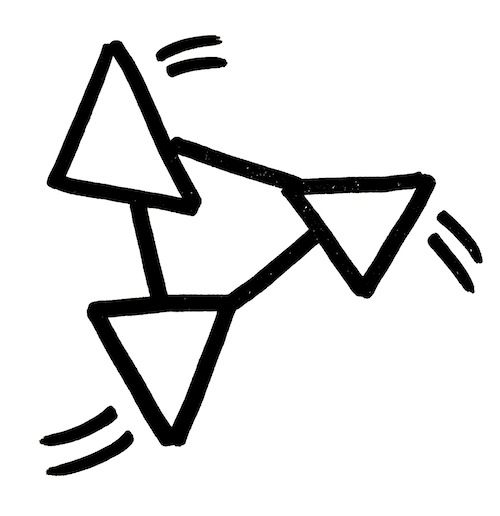
The Triangle of Music
Music, too, can be represented as a triangle whose vertices correspond to its physical, intellectual, and emotional components — each of which, in turn, is made up of a smaller triangle composed of three elements. This gives us nine key words, nine parameters that describe music in its essential aspects.
The physical vertex of this triangle is occupied by Technique and Reading, the intellectual one by the Elements of Music, and the emotional one by Sound.
Technique and Reading
In the triangle representing the physical side of music, we find only the tools needed for its performance — the “how”, more than the “what”; everything related to instrumental preparation and practice, rather than to understanding what is being played.
At its physical vertex — the one representing “Hands,” “Body,” “Strength,” or whichever term you prefer — we find Technique, meaning dexterity, speed, and precision in moving on the instrument.
The intellectual vertex is occupied by Reading, understood as the ability to turn written symbols into performed music. This is the dreaded “sight-reading” and includes pitch, duration, and the order in which sounds must be played.
At the emotional vertex, we find all the markings used to express the character of music: rallentando, accelerando, crescendo, diminuendo, fortissimo, pianissimo, etc. These are the Expressive Signs, further divided into agogic and dynamic signs. They define a kind of obligatory interpretation, because they’re written into the score — a form of imposed, almost mechanical emotion, unless further factors (which we’ll explore later) come into play.
To simplify, we could say that in this first triangle, technique provides the means to play, reading supplies the content, and expressive markings add a first form of rigid, premeditated emotion.
The Elements of Music
In the triangle located at the intellectual apex of music, we find what determines mastery over musical content—for example, the ability to compose or improvise. It answers the question “what” rather than “how”. The corners of this triangle are occupied by the elements into which music is typically divided: rhythm, harmony, and melody, which correspond respectively to body, mind, and heart. Let’s look at each one in turn.
Rhythm, in this context, does not refer to the rational understanding of rhythmic solfège or the technical skill needed to perform a certain rhythm—both of which belong to the previous triangle. Rather, it refers to what Leibniz defined as music: “a mathematical exercise of the mind that does not know it is counting.”
To clarify: subdividing a fast beat into sixteenth notes is difficult due to the technical challenge (technique), and understanding what sixteenth notes are is a matter of reading. In contrast, reproducing a simple pulse at a very slow tempo is difficult not because of knowledge or technique, but because it requires the ability to truly measure time. That’s what rhythm means here—the development of this inner skill.
Harmony is the domain of musical mathematics—the relationships between scales, chords, and intervals, which create a geometrical universe of sounds. For this reason, harmony represents the rational part of this triangle. Yes, rhythm is also mathematical, but that aspect has already appeared in the intellectual corner of the previous triangle, under reading and solfège.
Melody, or the choice of pitch, has a strongly emotional connotation. It’s no coincidence that even those who know nothing about music, rather than singing rhythms or chords, instinctively sing melodies. It’s hard to say what makes a sequence of pitches into a beautiful melody. Musicians call this the “melodic sense”, and it’s often considered an innate gift. Not all great composers had it. The usual example is Beethoven, a true giant who revolutionized music itself—he reinvented the orchestra and the role of the composer. Yet, he wasn’t particularly gifted in melody. But Beethoven is the proof that the will of a genius can overcome any limitation, even deafness. His poetry found full expression in the next triangle—the most important one for any musician, and the only truly indispensable one.
The Sound
A musician’s identity is expressed through their Sound. Not so much in the choice of notes, rhythmic patterns, or harmonic sequences—nor in technical skill or reading fluency—all aspects we've seen previously. In music, what truly matters is sound alone: what lies in the emotional triangle.
In physics textbooks, a sound wave is described by its duration, timbre, intensity, and pitch. Pitch corresponds to the melodic sense discussed earlier, while the other three elements sit at the vertices of this final triangle.
When duration involves many sounds, it gives rise to rhythm; but when considered in relation to a single sound, it enters the realm of microtiming—the rhythmic positioning of a note within the pulse. Every good musician knows that a note can be played precisely on the beat, slightly ahead of it, or slightly behind. Each option—fittingly matched here with Head, Hands, and Heart—involves variations of just a few milliseconds, yet produces a distinct psychological-musical effect: the Perfect Gear (on time), Pure Excitement (ahead), or Satisfied Suspension (behind). A skilled musician can master all three, but their identity naturally aligns with one of these microtiming styles. Amusingly, it’s often the same style that makes them show up early, on time, or late to appointments.
Timbre is what makes every human voice unique. This is because each sound is actually made up of many layered frequencies called 'harmonics'. If sound is a cake, harmonics are its ingredients—and the voice of every person, every instrument, and every musician has its own special and unrepeatable recipe.
The amplitude of a sound wave defines its intensity, or simply its volume. The full range of volume variation is called Dynamics, which occupies the emotional side of this third triangle. To grasp its importance, imagine someone with a beautiful vocal timbre and excellent storytelling rhythm, but who tells their story using the exact same tone of voice—whether it’s the beginning or end of a sentence, a dramatic moment or a calm one, a question or a statement. Dynamics—loud and soft—convey most of the emotional content, both in sound and in speech.
Sound as a whole is thus shaped by the history, personality, and character of a musician. It emerges in the way they articulate notes, with a particular timbre, at a particular volume. That’s why, if the first two triangles answer How and What, this last one answers Who—and for that reason, it is the most important. Because tools and techniques matter less than the person behind them.
A View from Above
Looking at the Triangle of Music, we can say with certainty that all great musicians have always possessed a strong "Who", often a strong "What", and sometimes a strong "How". It’s also interesting to note that in music schools, only the "How" can be systematically taught, and to some extent the "What"—while the "Who" is something that must emerge from within, as the result of a personal, often unconscious, journey in response to questions like: Who am I? What am I doing here? Why am I playing this instrument? A good teacher can certainly help in this process, but only as an external catalyst: the deepest content of music can be learned, but not taught.
By observing the three smaller triangles that form the Triangle of Music, we can find affinities among their vertices, which could themselves be placed on new Mani-Testa-Cuore triangles: Technique, Rhythm, and Microrhythm lie on the physical plane; Reading, Harmony, and Timbre on the intellectual one; Expressive Signs, Melody, and Dynamics on the emotional one.
I must admit, however, that the name "Triangle of Music" is actually improper, because it too sits at the top of an even larger triangle, still musical in content. In fact, many aspects have been left out so far; for example, if we answer the question "When", we could divide music into that composed in the past, in the present, or for the future, and to these three moments correspond three fundamental key words: Interpretation (hands), Composition (head), and Improvisation (heart).
Listening, Studying, and Interaction perhaps lie at the vertices of the "With Whom" triangle, which draws attention to the state we are in when we listen to relationships between other musicians, when we have a musical relationship with ourselves (innerplay), or when we relate with others (interplay).
Finally, if I answer the question "Why", perhaps the most important one, music can be divided into Craft (body), Art (mind), and Sharing (heart), where by sharing I mean the use of music to love others. Mestiere (corpo), Arte (mente) e Condivisione (cuore), dove per condivisione intendo l’uso della musica per amare gli altri.